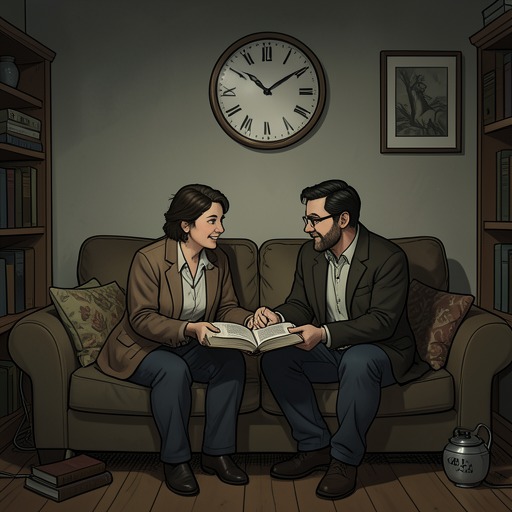
Home as belonging
The Time Traveler's WifeHome as belonging is a recurring concept in the novel, where home is not simply a building or a familiar address but the place made meaningful by attachment. Henry and Clare’s language of home shifts between playful familiarity and painful separation; their contrasting experiences show how a location can feel like home when shared with a loved one, and how quickly that feeling can become longing when the loved one departs.
Home as a Chosen Place
When Clare pulls into the circular driveway at her family house, she calls it “Home sweet home.” The phrase initially names a concrete destination, but the scene gives it a more intimate meaning. Later, after they have gone upstairs to separate rooms, Henry changes into pajamas, brushes his teeth, and sneaks into Clare’s room. He remembers to lock the door, and they settle together in her narrow bed. The modest particulars of the visit—separate rooms, a quietly closed door, shared warmth—make the house a place of private closeness rather than merely a family residence.
The homecoming is also connected to an unevenly shared past. Henry describes the future as a process of watching Clare move through memories that he has not yet experienced, until he has collected the complete set. Clare accepts that account, then explains that the events of her childhood have only “halfway happened” for him because he has not yet been there. When they later happen to him, she says, they will become real. Home, in this exchange, includes more than shelter: it is participation in another person’s history, even when that history reaches one of them at a different time.
The Body’s Sense of Home
The idea becomes more complicated in Henry’s account of the night in Clare’s bed. Their intimacy is careful and silent; afterward, Henry suffers an intense headache and briefly fears that he will disappear. He does not. Instead, he lies in Clare’s arms, while her snores seem painfully loud to him. The scene places bodily discomfort and emotional closeness side by side: the bed offers shelter and attachment, but it does not spare him the pain or uncertainty of his condition.
Henry’s thoughts then circle through familiar expressions about home. He imagines wanting his own bed in his own apartment and rehearses the comfort of “No place like home” and “Take me home, country roads.” But the refrain turns inward: his heart is with Clare, so he concludes that he must be home. The movement from apartment to bed, from remembered saying to present feeling, makes belonging a matter of emotional location rather than ownership. Clare sighs and grows quiet; Henry repeats to himself that he is home. The scene gives the idea its most direct personal force without resolving the tension between his old address and the place where he feels attached.
Christmas, Departure, and Loneliness
That sense of belonging is tested by the end of the Christmas visit. In the car, Clare dismisses the risk that her family might find the explanation of Henry’s appearances believable, and they laugh together. The laughter releases the tension that has accompanied them on the drive back to Chicago. But once Clare stops outside Henry’s apartment building, the ease of the journey gives way to separation: Henry takes his bag from the trunk and watches her drive away down Dearborn. His throat closes, and only hours later does he identify the feeling as loneliness. With Christmas over for another year, the parting makes clear that returning to his own building does not restore the closeness he has just left.
The chapter title, “HOME IS ANYWHERE YOU HANG YOUR HEAD,” makes a broader claim than the scene can simply confirm. The phrase suggests that home might be made wherever a person rests, but Henry’s departure from Clare reveals the cost of treating that possibility as sufficient. An apartment can be his place to return to without answering his immediate longing; conversely, Clare’s family house becomes home to him through the intimacy they share there. The idea holds both portability and absence: attachment can make a place feel like home, yet the person who creates that feeling may not remain beside him.
Belonging Beyond an Address
Across these moments, home is defined through a sequence of contrasts: Clare’s family driveway and Henry’s apartment building, separate bedrooms and one narrow bed, the expected comfort of familiar phrases and the ache of watching Clare leave. The repeated language of home does not erase these differences; it exposes them. A physical residence can provide continuity, but the scenes make emotional belonging depend on shared presence and on access to a life that is not yet equally remembered by both partners.
The concept also joins intimacy to time. Clare’s childhood events are not fully real to Henry until he experiences them, while the couple’s immediate closeness takes place inside a relationship shaped by those asynchronous memories. Their sense of home is therefore neither wholly fixed in the past nor guaranteed by a shared address. It arises in the present, in the bed they occupy together and in the understanding they build across unequal experience, then becomes newly visible as longing when they part. Home as belonging names not a stable place that cancels distance, but the attachment by which a place—or a person—can feel like home, and the absence that reveals how much that feeling depended on being together.